
Handwriting at St Mary’s
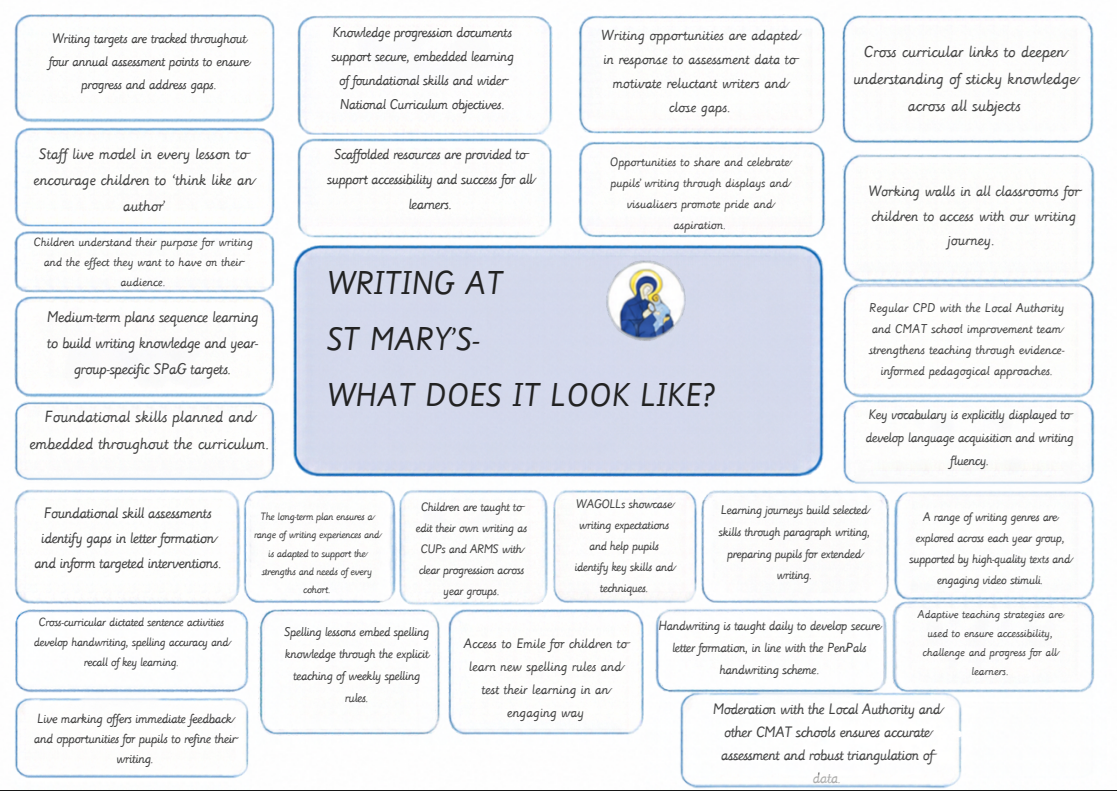
At St Mary’s, we recognise that fluent, legible handwriting is a key foundational skill that supports children in becoming confident and successful writers. We use the Penpals Handwriting Scheme to provide a consistent and progressive approach to handwriting across the school, ensuring that letter formation, orientation and presentation skills are systematically developed.
Handwriting is taught explicitly each week through dedicated lessons, which include opportunities to develop both gross and fine motor skills alongside the teaching of correct letter formation and joins. These sessions provide children with the foundations they need to write accurately, fluently and with increasing automaticity.
Handwriting expectations are reinforced throughout the week within English lessons and across the wider curriculum. Teachers consistently model letter formation and presentation using the visualiser, allowing children to observe the writing process and accurately transfer these skills into their own books. This regular modelling helps pupils develop secure habits and maintain high standards of presentation in all areas of learning.
We recognise that some children require additional support to secure the foundational skills necessary for successful handwriting. Through ongoing assessment, pupils with gaps in letter formation, pencil control or handwriting fluency are identified and provided with targeted interventions to address specific areas of need. These bespoke opportunities ensure children receive the support required to develop confidence and make sustained progress.
By combining explicit teaching, regular modelling, purposeful practice and targeted support, we aim to develop pupils who take pride in their presentation and possess the handwriting skills needed to communicate their ideas effectively.
Spelling at St Mary’s
At St Mary’s, we recognise that accurate spelling is a vital component of effective writing. Through the delivery of the Emile Spelling Scheme, children are taught the spelling patterns, rules and statutory word lists outlined in the National Curriculum. The scheme is carefully mapped to National Curriculum expectations, ensuring clear progression in spelling knowledge and skills across all year groups.
Spelling is taught through regular, discrete lessons each week, providing children with opportunities to learn, practise and apply new spelling patterns and rules. Lessons focus on developing a secure understanding of spelling conventions alongside strategies that support pupils in recalling and applying their learning within independent writing.
To support retention and application, weekly spelling words and patterns are prominently displayed within classrooms and regularly referenced throughout the week. Children are encouraged to discuss the meaning, structure and spelling of these words across the curriculum, enabling them to make connections between their spelling lessons and wider learning. These regular opportunities for retrieval, discussion and application help pupils embed spelling knowledge into their long-term memory.
Through ongoing assessment, teachers identify misconceptions and provide additional support where needed to ensure all pupils make progress and develop confidence as spellers. By combining explicit teaching, regular retrieval, purposeful discussion and meaningful application, we aim to equip children with the spelling knowledge they need to become accurate, confident and successful writers.
How Can You Support Your Child in Writing?
At St Mary’s, we strongly believe that reading is the single most effective way to support your child’s development as a writer. Regular reading exposes children to rich vocabulary, varied sentence structures and different authorial styles. It also helps children become familiar with correct spelling, punctuation and the organisation of texts, all of which can be transferred into their own writing.
There are many simple ways you can support your child at home:
- Read regularly together and discuss what you have read. Talk about interesting vocabulary, characters, settings and why an author has chosen particular words or phrases.
- Encourage purposeful writing opportunities in everyday life, such as writing shopping lists, birthday cards, labels, notes, postcards or invitations.
- Use recipes together, encouraging your child to read instructions, discuss sequencing and identify key vocabulary.
- Promote discussion and conversation, allowing children to rehearse ideas verbally before writing. Talking through ideas develops confidence, vocabulary and sentence structure.
- Practise weekly spellings and encourage your child to notice these words in books, signs and their wider reading.
- Celebrate writing at home, focusing on effort, creativity and improvement to build confidence and enjoyment.
By talking, reading and writing together regularly, children develop the vocabulary, knowledge and confidence needed to become successful writers.
-
Handwriting Policy 2026.pdf
pdf693.4 KbNov 24th, 2026
-
Parent Presentation Emile.pdf
pdf658.9 KbNov 24th, 2026
-
Spelling Policy 2026.docx.pdf
pdf698.1 KbNov 24th, 2026
-
Writing LTP 26-7.docx.pdf
pdf310.3 KbNov 24th, 2026
-
Writing Policy 2026..pdf
pdf1.2 MbNov 24th, 2026
-
Y4 MTP example.pdf
pdf1.2 MbNov 24th, 2026